Westlake Pond Topics
Fishing is a source of fun for a lot of people at Westlake. Despite age restrictions, people of all ages are fishing - let us know if you have thoughts about that.
Fishing does have a few negative impacts:
- A lot of debris is abandoned in the pond. Hooks and line frequently cause problems for the birds and turtles, and even those of us trying to do maintenance in the pond.
- Fishing with bluegill and pumpkinseed can lead to dangerous interactions with osprey and other fishing birds, who can dive at the bait and get hooked or entangled.
- The main "trophy" fish in Westlake is the non-native largemouth bass. As a predator, they eat baby birds efficiently. They also eat amphibians and their eggs.
- If you're a fish, you may oppose fishing on basic principles 😃.
People love to feed birds. Unfortunately, bird feeding is a big problem at ponds, especially a well-visited pond like Westlake. Impacts of bird feeding include:
- An unnaturally large number of human-adapted birds (e.g., mallards, coots, domestic ducks) remain at the pond. This limits natural migration, and displaces sensitive bird species.
- Bird food becomes bird poop (fertilizer). This causes algal blooms, reduced water quality, and adds to the already-thick muck layer.
- Even "healthier" bird feed isn't natural. Birds need a combination of fish, insects, plants and algae.
- High population & poop production increases bacteria levels (e.g., E. coli, avian-botulism-causing Clostridium botulinum, Salmonella, Aspergillus mold, and others). This can impact kids and anglers whose activity involves water contact, dogs who take sips of the pond, city maintenance staff who work in the water, and downstream habitats (neighbors, Neary Lagoon, and the ocean).
- Bird feeding encourages bird aggregation, leading to higher disease transmission and bird aggression.
- Unconsumed bird food attracts scavengers like rats, mice, raccoons and skunks – which creates an additional set of problems.
Respectfully, please do not feed the birds.
Did you know that Westlake Pond is a natural pond? Until the 1950s it was undeveloped, and it was donated to the city parks department in 1957. But there's so much more! Click here to read a longer history, and see cool historical photos of Westlake Pond
The tall plants in Westlake Pond are California Bulrush (Schoenoplectus californicus). Even though they are called reeds (grass-like plants), and their name says "bulrush", they are neither a grass nor a rush. They are sedges. Locally, they are often called tule, but this can be used to refer to cattails and other tall wetland plants. Go figure! We'll use "tule" for this discussion.
Tule is a native species and has likely populated Westlake Pond for milennia. It provides habitat for roosting birds (such as threatened tri-colored blackbirds) and nesting birds (such as mallards and coots). They provide protection for turtles and many other birds. They help clean water by absorbing nutrients and pollutants. They create varied habitats (such as shade, flattened tule, and vertical landing spots) that boost biodiversity.
The ideal balance from an ecological perspective is about 50% tule. But, if tule blocks your pond view, you may want less. Unmanaged, tule would cover most of shallow Westlake Pond.
Historically, the tule control strategy was to use heavy machinery every 2 years to remove it. This can damage the ecosystem. Our strategy is hand-removal of tule, which lets us avoid sensitive areas, gives mobile animals the chance to relocate, and allows us to adapt management as we observe & learn more.
Westlake Pond is spring fed. If you watch the weir (drain) at the south end of the pond, the water you see flowing out roughly equals the spring input. So why isn't Westlake crystal-clear?
First, a crystal-clear pond with no vegetation is not necessarily ideal - that clarity indicates a lack of food needed for a healthy ecosystem. The goal is balance.
Bird feeding adds fertilizer (aka bird poop) which induces heavy algal and plant growth. This can create habitat for mosquitos, make areas of the lake unnavigable to pond inhabitants, and can lead to fishing entanglements. In late summer, the excessive vegetation dies and decays, depleting pond oxygen levels. This promotes anaerobic bacteria in the sediment that produce stinky hydrogen sulfide and climate-harming methane.
Bird feces can also increase bacteria and virus levels in the pond that can impact other animals, and potentially increase health concerns for people. We test for E. coli. Some types of E. coli can cause illness, and its presence indicates the likely presence of other pathogens that exist alongside it in warm-blooded animals like birds and people. The E. coli source is important. If it's purely from bird fecal matter, the risk is generally lower for humans. If the source is human fecal matter, the risk is higher. We don't have complete information, but circumstantially it makes sense that most E. coli at Westlake comes from birds. That said, bird pathogens are not risk-free and it's prudent to be careful with water contact.
Another issue is stormwater runoff from the storm drain on Bradley Dr. During precipitation, runoff can bring fertilizer from nearby landscaping, street pollution, and other neighborhood inputs. We are exploring options/feasibility to address this.
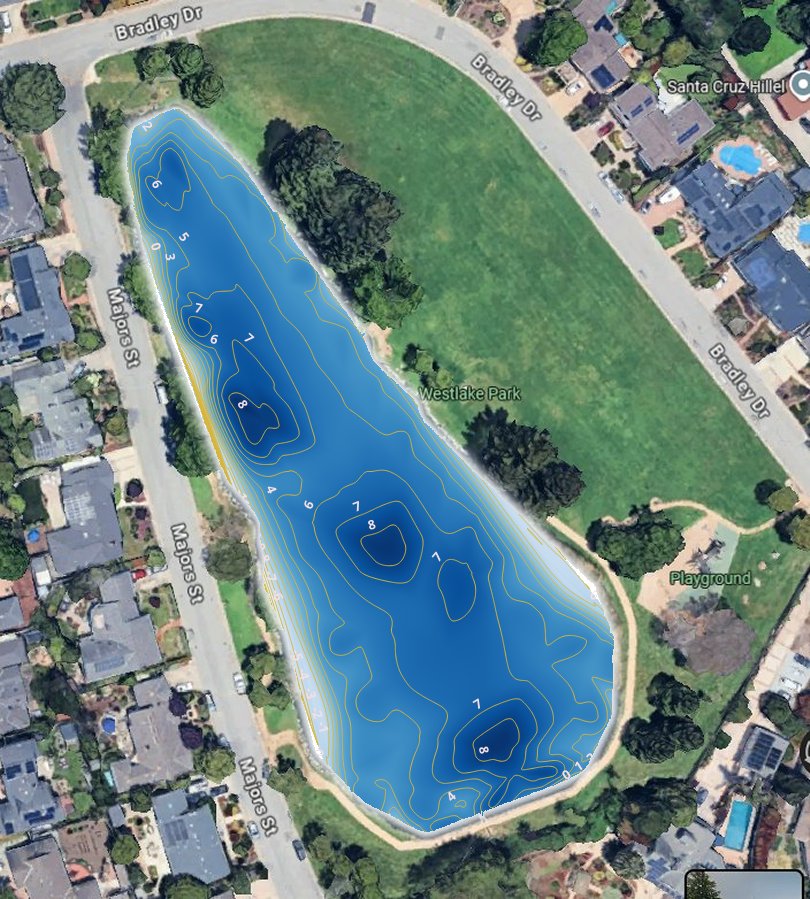
If you wander the perimeter of Westlake, you'll see that at its edge, the depth is 2-3 feet. But how does the depth change as you move further into the pond, and how is "depth" even defined? Why does it matter?
As you descend in the pond, you first pass through the water column. Then you arrive at the muck layer (soft sediment). And finally you stop when you reach the hard bottom - usually either sand or rock. We measured both "depth to the muck" and "depth to the solid ground". The "muck zone" ranges from 0 to 3 feet thick!
Muck depth and ground depth informs us about: oxygen issues, safety needs for maintenance staff, where vegetation will grow, water flow patterns, fish habitat, anchor requirements, and much more.
The north end of the pond has a lot of floating vegetation. Most of it gets blown there (rather than grown there).
In late summer/early fall, it begins to rot. When it rots in water with low oxygen, it creates methane (a potent greenhouse gas) and hydrogen sulfide (a stinky gas).
Removing the vegetation so it can decompose on dry land addresses this. It dramatically improves the ponds climate impact profile, and prevents the smells. It's also more aesthetically pleasing to most people.
Why is the vegetation there in the first place? Vegetation in a pond is natural. But there may be excess in Westlake Pond due to bird feeding, and nutrient input from stormwater that is piped into the pond.
Making pond management decisions requires balancing priorities of many stakeholders:
- Community: pond neighbors, other city-residents, anglers, families, pets.
- Ecosystem: animals & vegetation, both native and non-native.
- Government: providing recreation, water management, safety & liability, expense control.
Prioritizing stakeholder interests can be difficult. For example:
- It's tricky to manage tule for bird habitat, neighbor viewsheds, and fishing simultaneously.
- Diverting stormwater into the pond is easy - but it impacts vegetation management, water quality, and the pond's climate impact.
- Fishing is popular - but the bass eat newborn chicks, fishing with bluegill leads to raptor entanglement, and abandoned lures and monofilament are hazardous.
- Birdfeeding has historically been popular, but it's very problematic.
- Dog recreation can be wonderful – but it can conflict with other park stakeholders.